Introduction
On August 31, the US EPA published a Federal Register notice announcing that the agency will revamp its rules governing planning and prevention of accidental releases of highly hazardous air pollutants. These rules were first established in 1996 under Clean Air Act Section 112(r)(7), then revamped in a contentious process that ran from the end of the Obama administration through the beginning of the Trump transition. Generally known as the Clean Air Act (CAA) Risk Management Program (RMP), the rules require industrial facilities that store or use specific chemicals above a defined “threshold quantity” to develop hazard evaluations, onsite risk mitigation measures, and emergency response plans that coordinate with local agencies.
Environmental advocates – especially those working in or alongside environmental justice communities – have been pressing EPA to make changes to this program for years. Their primary motivation is protecting the people and environmental resources facing acute risks from chemical releases at nearby industrial facilities, but they have also raised concerns about the possibilities of multiple, simultaneous releases in areas with a high concentration of industrial facilities. The threat of such a disaster looms large over places like Louisiana’s Cancer Alley, where history shows that powerful storms can precipitate multiple chemical releases.
Climate change, as it drives sea-level rise, more frequent and intense storms, and wildfires, is liable to increase risks that should be addressed through the RMP rule updates.
EPA’s regulatory program, while authorized under the Clean Air Act, has implications for other environmental media. The facilities subject to RMP requirements are typically large and complex with a variety of hazardous materials on-site. It stands to reason that RMP-related hazard mitigation efforts intended to reduce the risk of air emissions will have co-benefits in terms of limiting the risk of hazardous chemical releases to surface water and land, too.
As we have witnessed repeatedly in the aftermath of coastal storms, flooding is a major risk factor at industrial facilities. Hurricane Harvey provided the most recent and vivid example, when the Arkema organic peroxides plant in Crosby, Texas suffered extensive damage from the storm’s floodwaters, resulting in toxic gas releases, fires, and thousands of pounds of contaminants migrating off-site in floodwater. The storage facilities at the Arkema plant did not even contain listed chemicals above the RMP “threshold quantities,” underscoring the likely hidden risks across the US and the importance of promoting industry-wide innovation through the program.
This policy brief explores how EPA, through this initiative to update RMP rules, might expand knowledge and application of nature-based solutions (NBS).
Mapping the Potential for NBS Investigations and Implementation
More than 10,000 industrial facilities across the US are subject to the requirements of EPA’s RMP because they use or store highly hazardous chemicals above EPA’s “threshold quantities.” Such facilities include oil refineries, wastewater treatment plants, meatpacking plants, and a variety of other industrial operations. According to a recent report from GAO, more than a third of RMP facilities is in an area that faces climate-related natural hazards including floods, coastal storms, and wildfires.

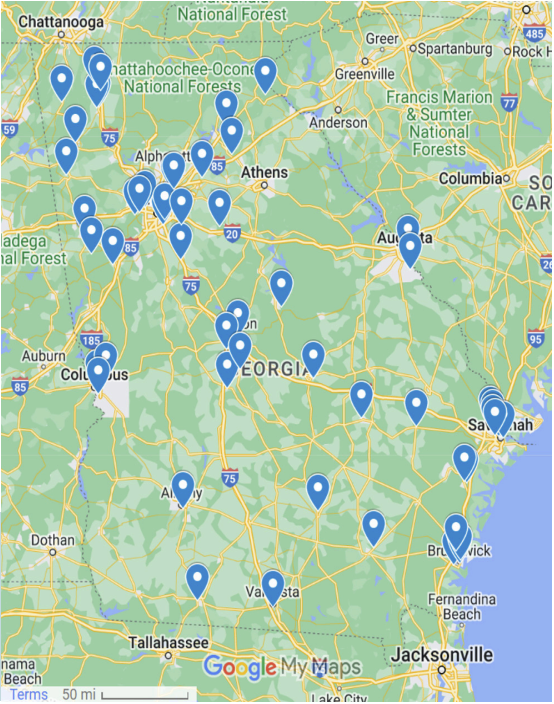
Using GAO’s dataset, which is drawn from regulated parties’ RMP submissions to EPA as well as NOAA and FEMA data on sea-level rise and flood risk, respectively, it is possible to develop a list of RMP facilities in Georgia that might be at risk from natural hazards. GAO’s dataset includes multiple hazard intensities (e.g., 100- and 500-year flood risks, inundation from a Category 1, 4,or 5 storm, and one or three feet of sealevel rise). Using search criteria that reflect highly likely events – inundation in a 100-year flood, in a Category 1 storm, or as a result of one foot of sea-level rise – produces a list of 57 high-risk facilities in Georgia. An interactive map, including social vulnerability index assessments for each facility drawn from the GAO dataset, is available online here and presented in a screen capture below. A cursory review of the 57 RMP facilities in Georgia reveals that more than a quarter are water and wastewater treatment plants, with food manufacturing, storage, or distribution centers also a significant subset.
EPA’s Opportunity to Promote Nature-Based Solutions
EPA’s RMP rulemaking initiative proposes numerous changes to the program, four of which offer opportunities to enhance knowledge and implementation of NBS. Each is described below. Before explaining how the RMP could contribute to the advancement of NBS, though, a brief overview of the program is in order.
The RMP is meant to prevent or limit the impacts of accidental releases of highly hazardous airborne chemicals. It is designed around a concept of tiered risk management, wherein relatively low-risk facilities have only basic risk assessment and risk management requirements, while relatively high-risk facilities warrant more comprehensive approaches. The level of risk – and, hence, level of effort required for RMP compliance – is based on the facility’s history of accidental releases, distance to human and environmental “receptors,” and whether the facility has coordinated emergency response procedures with local authorities. The RMP has three tiers: Program 1, which mandates minimal requirements for documented hazard evaluation; Program 3, which has extensive hazard evaluation and risk management requirements and is primarily intended to cover the chemical industry; and Program 2, which fits somewhere in between.
Whether a covered facility is subject to the requirements of Program 1, 2, or 3, there is potential for advancing knowledge and implementation of nature-based infrastructure solutions for facility-scale risk management. In the pages that follow, we explore those connections.
Hazard Assessment and Nature-Based Solutions
As part of this rulemaking initiative, EPA plans to update the hazard evaluation requirements for RMP facilities. EPA has proposed two notable changes to the Program 2 “hazard reviews” and Program 3 “process hazard evaluations.”
First, recognizing that “natural hazards” such as floods and storms create the possibility of chemical disasters and that climate change is amplifying these hazards, EPA has proposed new regulatory language to ensure that covered facilities adequately assess “external events such as natural hazards, including those caused by climate change or other triggering events that could lead to an accidental release.” (1) EPA argues that covered facilities should be assessing natural hazards under existing rules, and that the new regulatory language simply clarifies that longstanding requirement for owners and operators who were unclear about it.
Second, EPA has proposed new language concerning the siting of RMP facilities and covered processes. Focusing on the consequences of improper siting, EPA notes that the location of RMP facilities in relation to public and environmental receptors “can impact the surrounding community not only through the proximity of the accidental release to offsite receptors adjacent to the facility boundary (e.g., people, infrastructure, environmental resources), but also through increasing the likelihood of a secondary ‘knock-on’ releases by compromising nearby processes.” (2) To limit these siting-related risks, EPA is proposing to new language related to siting analysis in the regulations governing Program 2 hazard reviews and Program 3 Process Hazard Analyses. (3) Again here, the agency is arguing that covered facilities should be assessing siting under existing rules and that this new regulatory language simply clarifies matters for owners and operators who were unsure.
EPA’s regulatory text will not delineate exactly how facility owners and operators should conduct hazard evaluations. Instead of step-by-step instructions or even a comprehensive checklist of issues to investigate, EPA provides regulated parties advice in the form of non-binding guidance documents and the flexibility to follow hazard evaluation procedures developed by non-governmental standard-setting organizations such as the American Institute of Chemical Engineers’ Center for Chemical Process Safety (AIChE CCPS).
(4) These updated analytical requirements related to natural hazards and facility siting create an opportunity for developing new knowledge about NBS implementation. For instance, facilities located along rivers or in coastal areas (e.g., the 57 Georgia facilities mapped above) will need to consider flooding and storm surge, along with the effects that climate change will have on the likelihood and severity of those events. Guidance should encourage that analysis to be based on hydrological modeling, including a basic review of predicted high-water levels and wave action in one percent and 0.2 percent annual probability events (i.e., 100-year and 500-year storms), focusing on the buildings and processes susceptible to flooding under those scenarios. That modeling could be enhanced with additional analysis that takes into account the effect that NBS such as coastal marshes and engineered wetlands would have on flood levels. That is, in addition to modeling future conditions in terms of climate change – as required under current and amended regulations – a facility owner or operator should model future conditions in terms of planned facility upgrades using natural and nature-based features.
Such analysis would be consistent with the industry guidelines that EPA highlights in the rulemaking proposal as being useful for informing natural hazard and siting analyses under the revised regulations. For instance, EPA mentions the AIChE CCPS “Guidelines for Siting and Layout of Facilities” as a useful tool for enhanced hazard review and process hazard analysis. The AIChE CCPS facility siting guidelines encourage facility owners and operators to analyze natural hazards such as severe storms and flooding primarily in initial site selection.5 The concepts and methods of analysis outlined there include gathering information about floodplains, rainfall patterns, storm risks, and topography – all factors that could lead to analyses of the role of NBS as ongoing risk management tools, even after initial siting and layout decisions are made. EPA could improve upon the AIChE CCPS guidelines by providing guidance to facility owners on how to model future climate conditions and their impacts on natural hazards.
Prevention Program Requirements and Nature-Based Solutions
Roughly 10,400 RMP facilities across the US must go beyond developing a hazard evaluation and also create an RMP-compliant prevention program that dictates safe operating procedures, employee training, inspection and maintenance programs, compliance audits, post-accident investigations, and more. For a subset of roughly 560 Program 3 facilities, EPA is proposing an enhancement to the prevention program requirements, mandating what is called a “Safer Technologies and Alternatives Analysis” (STAA). The STAA requirement would apply to densely co-located high-risk facilities, primarily petrochemical facilities located within a mile of one another. It would mandate that the facility owner or operator “consider the application of the following safer technology measures, in the following order: inherently safer technology (IST) or inherently safer design (ISD), passive safeguards, active safeguards, and procedural safeguards.” (6)
For a subset of Program 3 facilities, EPA is proposing a requirement that they
undertake Safer Technologies and Alternatives Analysis (STAA). As EPA explains it,
considering inherently safer technology or design (IST or ISD) generally involves
analysis of four “inherently safer strategies:”
- Substitution: replacing hazardous materials with less hazardous substances
- Minimization: using smaller quantities of hazardous substances
- Moderation: creating less hazardous conditions or using less hazardous forms or facility designs to minimize the impact of potential releases of hazardous materials or energy
- Simplification: designing facilities to eliminate unnecessary complexity and make operating errors less likely (7)
The moderation strategy, with its underlying concepts of creating less hazardous conditions and using less hazardous facility designs have potentially interesting ties to NBS, and the proposed explicit regulatory requirement that facility owners and operators consider passive safeguards (8) suggests opportunities for researching and deploying natural and nature-based features.
Underscoring the need for more research on NBS related to natural hazards in the chemical safety context, an influential 2017 book on “natech events” (combined natural disaster and technological failures) includes two relevant findings. (9) One is that facility owners and operators have insufficient guidance on how they can address extreme weather risks. The other is that the owners and operators exhibit an over-reliance on generic design criteria that do not take into account the site-specific extreme weather risks. The proposed STAA requirements could lead to valuable new knowledge on NBS that could fill these gaps.
While potentially meaningful for the field of NBS study, EPA’s proposed STAA rules have two notable limitations. First, as proposed, the STAA rules only require facility owners and operators “to identify, evaluate, and document the practicability of implementing inherent safety measures.” The new rules would not require owners and operators to adopt such measures. The STAA requirement would create an immediate demand for place-based analysis of NBS, but may have limited impact on actual implementation. Second, EPA is only proposing to mandate STAA for densely co-located refineries and chemical manufacturing facilities (e.g., those in Louisiana’s “Cancer Alley”). (10) Thus the STAA requirements that might lead to investment in NBS research and implementation would only apply to a few hundred of the more than 10,000 RMP facilities in the US covered by Program 2 and 3 requirements. While this limited applicability could certainly be a weakness in terms of NBS research and implementation potential, another viewpoint is that the design might create an incentive for densely co-located facilities to pool their resources for investigation, piloting, or implementation of landscape-scale NBS. Several of these groupings are likely located in the Gulf Coast region, where mangroves, living shorelines, barrier islands, and other NBS could be established, if supported by adequate funding and partnerships.
Root Cause Analysis
Incidents involving the uncontrolled release of hazardous chemicals are so difficult to prevent that they seem inevitable. EPA identified nearly 500 such incidents that met a regulatory threshold for reporting under the RMP between 2016 and 2020. (11) Seventy facilities had the dubious distinction of having been the site of multiple reportable incidents in that five-year period, some even tied to the same underlying causes and processes.
Recognizing the value of understanding and learning from mistakes, EPA is proposing new requirements for “root cause” analysis of certain chemical releases. Under current rules, following an accidental release of hazardous chemicals, facility owners and operators must identify the causal factors behind the incident. A causal factor is a “major unplanned, unintended contributor to an incident … that if eliminated would have either prevented the occurrence of the incident or reduced its severity or frequency.” (12) The proposed new RMP rules go further, asking facility owners and operators to extend their analysis to identify the root cause – the “fundamental, underlying, system-related reason why an incident occurred.” (13) Thus, whereas today an incident investigation following a disaster like the one that happened at the Arkema facility during Hurricane Harvey might report “unusual weather” and “equipment failure” as causal factors and end there, root cause analysis would go further and might determine that the fundamental reason the incident occurred was insufficient flood risk management infrastructure.
Under the proposed new rules, root cause analyses must be conducted “using a recognized method,” (14) and EPA cites with approval the American Institute for Chemical Engineers’ Center for Chemical Process Safety’s (AIChE CCPS) “Guidelines for Investigating Chemical Process Incidents.” (15) The AIChE CCPS guidelines present several structured approaches to root cause analysis, some of which are likely to lead investigators to assess the role of site environmental conditions. For instance, the guidelines condone the use of predefined logic trees and checklists to steer investigations. An example of a predefined tree provided in the text shows “natural disaster” as one of four major problem categories (along with “human performance difficulty,” “equipment difficulty,” and “other”),16 and it might be presumed that an investigation following the natural disaster path would home in on flood risk management and the potential role of natural and nature-based features as a solution.
Here again, the true impact on NBS knowledge development may be somewhat limited, based on the universe of covered facilities and incidents. The root cause analysis rules would apply to facilities covered by the Program 2 and Program 3 requirements, which amounts to approximately 10,400 facilities nationwide. And a release is only reportable (and hence would be subject to root cause analysis under the new rules) if it was a release of a covered substance at a covered facility from a covered process that resulted in specific impacts such as death, injuries requiring medical treatment or hospitalization, onsite or offsite property damage, sheltering-in-place, or evacuations. According to a database of RMP-reportable incidents compiled by EPA going back to 2004, there are roughly 100 reportable incidents per year. A 2019 analysis of RMP-reportable incidents found very few happened during extreme weather events,17 although that history should be taken with a grain of salt given the narrow reporting requirements. It is worth considering GAO’s recent analysis of Program 2 and 3 RMP facilities located in areas at risk of floods, hurricane storm surge, sea-level rise, and wildfires.18 GAO’s database identifies more than 5,100 facilities confronting those natural hazards.
Thus, the new root cause analysis rules may create an interesting universe of case study opportunities for NBS researchers. As those case studies develop and proliferate, investigators undertaking root cause analyses for reasons other than RMP compliance may benefit from their methods and findings. For instance, the US Chemical Safety and Hazard Investigation Board (commonly known at the CSB) is an independent investigative body that undertakes root cause analyses of various incidents and might benefit from findings about the impact natural and nature-based features can have in facility-scale risk management. EU member states require certain industrial operations to investigate the link between environmental hazards and chemical accidents under the Seveso III Directive.19 As knowledge production relating natural and nature-based features to industrial safety develops, it could have worldwide implications.
Third-Party Compliance Auditing
EPA is only able to conduct compliance investigations for a small fraction of RMP facilities in any given year. To ensure that RMP prevention programs are more than mere paper tigers and that the procedures and practices developed under those programs are adequate and being followed, RMP rules require Program 2 and Program 3 facilities to undertake compliance audits on a triennial cycle. (20) In contrast to incident investigations that might only focus on one aspect of a prevention program even with the proposed root cause analyses, compliance audits “help to ensure a systematic evaluation of the full prevention program for all covered processes.” (21) With this new rulemaking initiative, EPA is proposing to enhance the compliance audit provisions of the RMP by requiring facility owners and operators to hire an independent, third-party auditor to conduct compliance audits after certain triggering events – namely, after two accidental releases in a five-year period or a single accidental release at a petrochemical facility that is densely co-located with other similar facilities. (22)
Compliance audits present another opportunity for investigating the value of NBS for facility-scale risk management, if EPA encourages the auditors to develop competency in NBS. Under the proposed regulations, third-party auditor competency requirements are rather vague. The proposed language states that third-party auditors shall be (A) “knowledgeable with the requirements” of the RMP; (B) “experienced with the stationary source type and processes being audited and applicable recognized and generally accepted good engineering practices;” and (C) “trained and/or certified in proper auditing techniques.” The first and second elements of these competency requirements could be connected to NBS. Once the new requirements related to assessing natural hazards in hazard evaluations and process hazard analyses take effect (as noted above), being “knowledgeable with the requirements” of the RMP should involve some knowledge of NBS as a risk management tool. Similarly, recognized and generally accepted good engineering practices might include the use of natural and nature-based features.
Conclusions and Recommendations
EPA’s proposed changes to RMP regulations make important strides towards better
protecting people and the environment from chemical disasters. Given the large
number of RMP facilities facing flooding and storm surge hazards and the growing
base of scientific evidence showing how natural and nature-based features can
reduce the risks posed by those hazards, EPA should look for opportunities to use
the RMP regulations and guidance to enhance consideration and implementation of
NBS. EPA can do this by:
- Referencing in preamble text NBS-related guidelines relevant to hazard evaluation (including identifying natural hazards and siting issues), process hazard analysis, and STAA requirements;
- Such guidelines might include the USACE/ERDC “International Guidelines on Natural and Nature-Based Features for Flood Risk Management” (23)
- Updating RMP guidance documents to encourage analysis of NBS in hazard evaluation, process hazard analysis, STAA, and chemical accident root-cause analyses;
- Training RMP compliance and enforcement staff on the utility of NBS for disaster risk reduction.
Footnotes
1. US EPA, “Accidental Release Prevention Requirements: Risk Management Programs Under the Clean Air Act; Safer Communities by Chemical Accident Prevention,” 87 Fed. Reg. 53,556, at 53,568, 53,610, 53,612 (Aug. 31, 2022).
2. Id. at 53,571.
3. Id. at 53,573-4, 53,610, 53,612.
4. Id. at 53,556, 53,574.
5. AIChE CCPS, “Guidelines for Siting and Layout of Facilities” at 59-62, New Jersey: Wiley (2d ed., 2018), https://doi.org/10.1002/9781119474821.687 Fed. Reg. at 53,575, 53,612.
7. Id. at 53,575.
8. Id. at 53,581, 53,609, 53,612.
9. Krausman, Cruz, and Salzano, “Natech Risk Assessment and Management: Reducing the Risk of Natural-Hazard Impact on Hazardous Installations” Oxford: Elsevier (2017).
10. EPA is also proposing to require STAA for a subset of refineries that still use hydrogen fluoride in an alkylation unit, regardless of distance to other facilities, but that requirement isn’t particularly relevant to this discussion.
11. 87 Fed. Reg. at 53,582.
12. Id. at 53,582, citing AIChE CCPS, “Guidelines for Investigating Process Safety Incidents,” John Wiley & Sons, Ltd (3d ed., 2019), https://doi.org/10.1002/9781119529132.
13. Id. at 53,583, 53,609.
14. Id. at 53,583, 53,612, 53,614.
15. Id. at 53,582.
16. AIChE CCPS, “Guidelines for Investigating Process Safety Incidents,” John Wiley & Sons, Ltd (3d ed., 2019), https://doi.org/10.1002/9781119529132.
17. US EPA Office of Land and Emergency Management Office of Emergency Management, “Technical Background Document for Final RMP Reconsideration Rule Risk Management Programs Under Clean Air Act, Section 112(r)(7)” (July 18, 2019), available in EPA Docket No. EPA-HQ-OLEM-2022-0174, Document EPAHQ-OLEM-2022-0174-0029.
18. GAO, “Chemical Accident Prevention: EPA Should Ensure Regulated Facilities Consider Risks from Climate Change,” GAO-22-104494 (Feb. 2022).
19. See Center for Progressive Reform, Earthjustice, and Union of Concerned Scientists, “Preventing ‘Double Disasters:’ How the U.S. Environmental Protection Agency can protect the public from hazardous chemical releases worsened by natural disasters,” at 10 (July 2021), available at https://cpr-assets.s3.amazonaws.com/documents/preventing-double-disasters-final.pdf
20. 40 CFR §§ 68.58(a), 68.79(a).
21. 87 Fed. Reg. at 53,584.
22. Id. at 53,584, 53,612.
23. T. Bridges et al., “International Guidelines on Natural and Nature-Based Features for Flood Risk Management,” US Army Corps of Engineers Engineering Research and Development Center Special Report no. ERDC SR-21-6 (2021), at http://dx.doi.org/10.21079/11681/41946.