
Levee Setbacks: An Introduction
Flowing from the glaciers on Mount Rainier into Commencement Bay in Tacoma, Washington, the Puyallup River and its watershed drain nearly 950 square miles of Pierce and southern King Counties. A system of levees built by locals between the 1930s and the 1960s – including the Jones Levee and the Matlock Cuto, Calistoga, Ford, and High Cedars levees – facilitated growth and development in the region. (1) Throughout the watershed, these and other flood control structures have all been breached or damaged by severe flooding events at various times since the 1990s, leading to costly damages to property, mass evacuations, and millions of dollars of losses.
The city of Orting, located at the confluence of the Puyallup River and one of its main tributaries, the Carbon River, is a growing town with expanding urban areas and agricultural land uses. Orting is subject to endemic flooding: Nearly 80 percent of the city is within the 100-year floodplain. Severe flooding in 1996 destroyed several homes upstream of Orting, damaged hundreds of feet of the Ford Levee, and threatened an important local roadway. As part of the recovery process, around 10,000 feet of the Ford Levee was subsequently set back from the river channel, thereby reconnecting 120 acres of floodplain. FEMA’s Hazard Mitigation Grant Program provided buyout funds for the setback levee. (2)
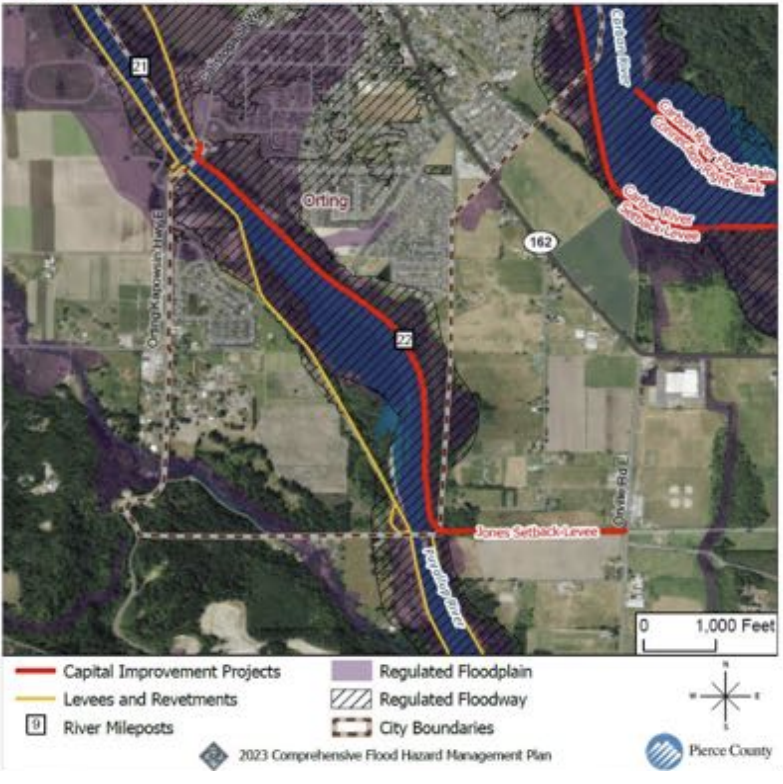
The Jones Levee provides critical protection for Orting (Figure 1). (3) Setting back the Jones Levee would reduce the overall flood risk to residents, protect critical infrastructure, and allow growth and development to continue. The setback would reconnect 40-50 acres of historical floodplain, reestablish ecosystem functions and services, and replenish habitat for salmon and other wildlife. Similar to the Ford Levee setback, implementing the Jones Levee setback means acquiring publicly and privately owned lands. In this case, almost 84 acres are spread across 26 parcels that include agricultural and residential land uses, open space or recreational uses, and utility and public rights-of-way. (4)
A setback levee realigns an existing levee or constructs a new levee located away from the active river channel, thus hydrologically reconnecting a river with its historical floodplain. Unlike a traditional levee that is gray infrastructure built alongside the active river channel, a setback levee blends both green and gray infrastructure. It makes use of the historical floodplain for valuable ecosystem services such as water retention, absorption, and filtration; riverine and wetland habitat; and recreation, reinforced by a man-made flood control structure (Figure 2). Together this combination of gray-green infrastructure reduces flood hazards for the surrounding community. The Ford and Jones setback projects in Washington illustrate growing awareness of myriad benefits from incorporating ecological principles into infrastructure design and of how “leaving room for the river” can enhance long-term resilience to flooding.

One critical step to implementing a levee setback is to purchase properties between the river and the riverward side of the newly located levee so that the floodplain can be restored as open space. These voluntary property buyouts are an increasingly common strategy to reduce or avoid costly flood losses altogether by permanently moving people and properties out of harm’s way. A local government or entity purchases a home from a willing seller in an area of high risk, demolishes that property so it can no longer be occupied, and maintains the land as open space in perpetuity. As a result, the flood risk to lives and property is eliminated at that location. Yet the buyout and relocation process can have an array of social and economic consequences for affected households and communities which should be carefully considered when administering a levee setback.
Implementing hybrid green-gray infrastructure such as a levee setback is one goal of “Engineering with Nature” (EWN®), a vision with a growing community of practice within the U.S. Army Corps of Engineers (USACE). EWN is the “intentional alignment of natural and engineering processes to efficiently and sustainably deliver economic, environmental, and social benefits through collaboration” to meet the water resources development needs of communities across the United States. To achieve this alignment, practitioners seek solutions that are holistic, sustainable, science-based, cost effective, socially responsive, and innovative. The Institute for Resilient Infrastructure Systems (IRIS) at the University of Georgia seeks to integrate natural and conventional infrastructure systems to strengthen long-term resilience to flooding, sea level rise, drought, and other natural weather and climate-change driven disruptions. Together with USACE, IRIS is a founding partner of the Network for Engineering with Nature (N-EWN), a collaborative group of interdisciplinary researchers, educators, and practitioners that work together to implement the principles of EWN.
This primer follows an earlier publication, IRIS in Focus: A Legal, Regulatory, and Policy Primer on Levee Setbacks, that laid the foundation for interested communities to begin strategizing how to implement a levee setback. (6) The goals of this primer are to identify the practical challenges of voluntary property buyouts as described in the social sciences literature and to explain how those challenges apply in the specific context of a levee setback pursued under USACE authority.
This primer begins by highlighting key differences between a general voluntary property buyout and those occurring as part of a federally funded and designed levee setback project (setback-related buyout). Next, this primer details some of the key lessons learned from the social sciences literature about general voluntary property buyout programs – including the geographic distribution, the process and implementation of these programs, the factors that encourage or discourage households to participate, and the outcomes of these programs – and how these lessons may apply in the levee setback context. In each section, we provide recommendations specific to the levee setback context to facilitate participation in a buyout program.
Key Recommendations for Implementing Voluntary Property Buyouts for a Levee Setback
- Plan ahead. A community interested in a levee setback should begin considering voluntary property buyouts as one of the first steps in the planning process.
- Shorten the time to complete a voluntary property buyout. A community should investigate funding opportunities from federal, state, and other sources to help with buyout costs, apply to funding sources that do not require disaster declarations or that provide pre-disaster funding, and – in a post-disaster context – apply as quickly as possible for funding.
- Coordinate support for a buyout program. A community should build administrative capacity for a buyout program by involving different government entities, non-profits, and local businesses such as housing authorities, realtors, attorneys, and community advocacy groups.
- Collaborate and build relationships within the community. A community interested in a levee setback should proactively initiate conversations with affected property owners, identify their priorities and interests, and assess the potential social and economic impacts of a buyout program.
- Use established community and social networks to maximize participation and collaboration. Outreach to community members should be integrated into existing community gatherings where possible or utilize other traditional means of community engagement and collaborative problem-solving.
- Provide financial assistance to help buyout participants throughout the relocation process. A voluntary buyout program should include assigning liaisons, counselors, or case workers who are accessible by phone or in person to assist participants and provide timely updates throughout the process.
- Consider a levee setback project within the context of local land use and growth management. Especially where loss of housing stock and tax revenue are likely to be issues, administrators should proactively seek opportunities to construct new housing or revitalize existing structures in more secure areas.
- Collect standardized data to better understand post-buyout outcomes. Buyout administrators should prepare consistent intake forms and data collection methods that maintain contact with participating households to better understand the relocation outcomes at the household, neighborhood, and community levels.
Voluntary Property Buyouts for Levee Setbacks
A community with a traditional levee typically begins considering a levee setback in the aftermath of a significant levee failure or a history of repeated failures that cause severe damage. A setback becomes an appealing alternative when:
- Extensive damage to the foundation or sections of the levee makes repairs cost-prohibitive and renders a setback more cost-efficient by providing the same or greater protection;
- Land is available for a setback levee, and resources are available to acquire that land; and
- The community is interested in the secondary benefits of floodplain restoration. (7)
This second factor is critical. To construct a setback levee, the necessary real estate includes the footprint of the new levee and the land within the floodplain that will be restored (formerly landward of the traditional levee). Sometimes a willing seller may also insist on selling their entire parcel, including excess land that is landward of the setback levee but not part of the design footprint, so that the seller is not left with a partial parcel of land.
USACE is typically the main federal partner that is authorized and appropriated funds to build a levee setback. (8) Congress can authorize and fund a setback levee through USACE’s Civil Works mission in a Water Resources Development Act, which are passed every other year. Alternatively, a setback levee could be implemented following a disaster under USACE’s Emergency Response to Natural Disasters authority, commonly known as PL 84-99. (9)
A local, non-federal sponsor such as a local government, county planning agency, or levee district is responsible for providing the land, easements, rights-of-way, relocations, and disposal (LERRDs) for a levee setback project. The non-federal sponsor is also responsible for sourcing the borrow material needed for levee construction. Some of the non-federal cost-share requirements can be met with credit for LERRDs. Local governments may also use federal funding from other agencies, such as the Federal Emergency Management Agency (FEMA), the U.S. Department of Housing and Urban Development (HUD), or the Natural Resources Conservation Service (NRCS), to purchase properties.
It is critical to stress that voluntary property buyouts are – and must be – voluntary. The Fifth Amendment of the U.S. Constitution prohibits the taking of private property without just compensation. Federal, state, and local governments may exercise the power to eminent domain for public purposes (such as flood control projects) but they must provide compensation to private landowners to do so. In practice, using eminent domain to acquire flood-prone properties and to compel homeowners to relocate is politically unpalatable. Moreover, federal buyout funds from programs administered by FEMA or HUD require voluntary participation and prohibit any coercive tactics. (10)
A voluntary property buyout for a levee setback shares many similarities with a general property buyout, with a few key distinctions that stem from differing objectives. All buyout programs broadly seek to mitigate flood risk by moving people and property out of harm’s way. For a general property buyout program, the environmental benefits – from maintaining contiguous properties as open space or creating pocket parks of open space, for example – are secondary. In a levee setback context, a specific objective is to restore the ecosystem services of the floodplain and to use green infrastructure to provide flood hazard reduction benefits and reduce the likelihood of future flood losses. These priorities shape the process and implementation, participation, and social outcomes of voluntary property buyout programs.
Since the priority of a general voluntary property buyout program may simply be to relocate as many households and structures out of a floodway as possible, a patchwork of households that participate and households that remain is an acceptable outcome. The decision of a household to participate involves a complex calculation of risk perception, social pressures and connections, and often timing. Also, the attachment to a place is a powerful reason to stay.
In a levee setback context, all properties within the setback levee design must be purchased and removed because anything riverward of the setback levee will be unprotected. A single holdout can defeat the purpose of restoring the floodplain and the chosen design of a levee setback, and the consequence is that the project either does not move forward or must be redesigned. That the buyouts must essentially be all-or-nothing has implications for the planning and implementation process and the social pressures for households to participate.
| General Voluntary Buyouts | Setback-related Buyouts | |
| Goal | To eliminate flood hazard to people and properties | To restore river and floodplain connection as a means of bolstering flood-protection from a levee |
| Properties | Any interested and qualified property; properties do not have to be contiguous | All properties within the levee setback design |
| Buyout Property Use | Open space | Restored floodplain and levee footprint |
| Timing | Post-disaster and some ongoing | Authorized in federal legislation, or post-disaster |
| Timeline | Ongoing, potentially open-ended | Aligns with setback construction |
| Buyout Funding Sources | Federal, state, or local funds | Federal, state, or local funds |
Second, the timing of a levee setback and the buyout process may be more predictable and clearer than a general buyout program, depending on the legal authority used to authorize the setback. Greater predictability and clarity tend to lead to more participation in a buyout program. For example, a levee setback that is authorized by Congress and that is not disaster-dependent may allow more time for planning and designing the levee footprint, collecting community input, assessing real estate needs, and applying for funding.
Importantly, the planning and design phases of a non-emergency response USACE civil works project will include a timeline for the voluntary property buyout process, giving potential participants a greater sense of clarity on when they will have to relocate. In addition, support staff and resources to implement property buyouts related to a levee setback may be built into the project funding because it is a key component of the project. The large-scale floodplain reconnection and ecosystem restoration goals may also attract the interest and assistance of environmental NGOs with experience in all phases of voluntary buyout programs, such as The Nature Conservancy or Ducks Unlimited.
In contrast, disaster-dependent general buyout programs, and levee setbacks pursued under the USACE’s emergency response authority, tend to be implemented in the months and years following a catastrophic flooding event. The stress of a traumatic event can both encourage participation by motivating property owners to relocate so as not to experience flooding again or discourage participation buyout programs if the process takes too long or seems too uncertain or chaotic.
The Geography of Voluntary Property Buyouts
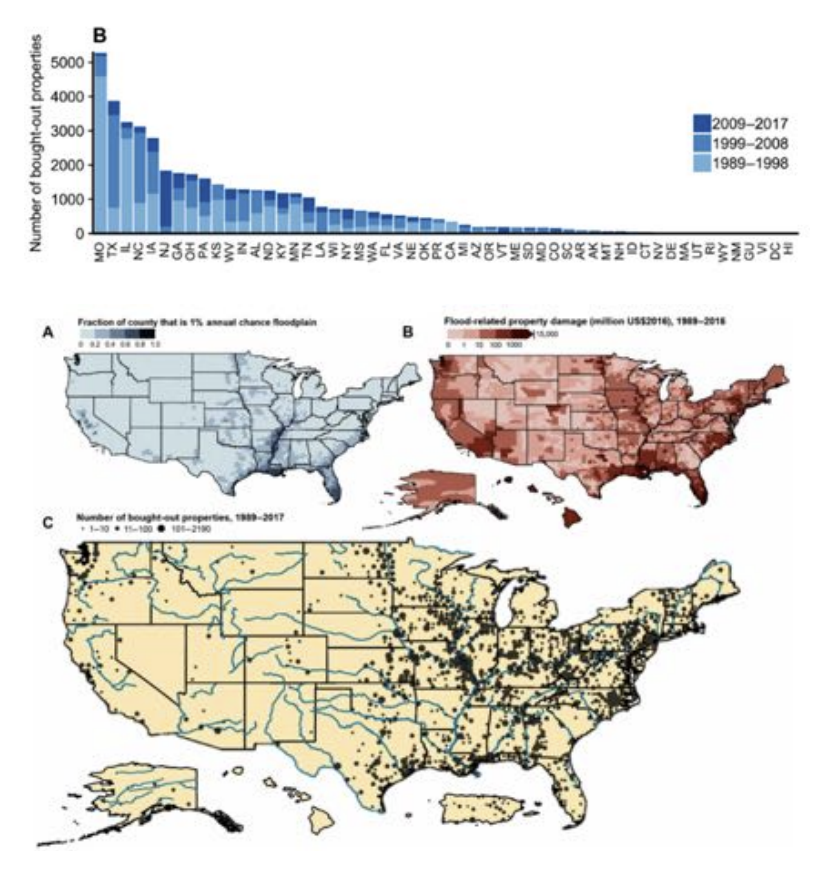
Voluntary property buyouts have occurred throughout the United States with generally predictable distributions: Areas with more flood damage have seen more property buyouts.
Between 1989 and 2017, FEMA funded 43,633 voluntary buyouts of high flood-risk homes in over 1,100 counties across 49 states (Figure 3). (11) The majority of counties that have implemented a FEMA-funded voluntary buyout have only purchased three or fewer properties. However, nine counties in Texas, Missouri, Alabama, New Jersey, and North Carolina have administered more than 500 buyouts per county, (12) with Harris County, Texas, topping the list at over 3,000 properties. (13) Although the distribution of buyouts is correlated to flood risk and property damage, there are several important outliers. The coastal states of Florida, Louisiana, and Mississippi rank among the top ten for cumulative flood-related damage, but these states have not prioritized voluntary buyouts as a flood-mitigation strategy. (14) No specific data exist on how many buyouts have occurred as a result of levee setbacks.
Counties that participate in general voluntary property buyouts tend to be wealthier and more urban, possibly due to greater administrative and funding resources of local governments to oversee the buyout process. Buyout programs require substantial investments of time and local government capacity to manage complex grant applications, acquire supplementary funding, communicate with property owners and residents, and identify new properties to relocate displaced households – all factors that can constrain participation. In addition, other benefits of buyouts such as enhanced recreation opportunities and preserved open space tend to be more valued as amenities in urban areas, where parks and other open space may be less common due to higher density development. (15)
Yet these patterns diverge when moving from the county level to the neighborhood or zip code level. Within the wealthier and more urban counties that participate, buyouts tend to occur in zip codes that have lower population densities, greater racial diversity, and higher markers of social vulnerability. (16) Majority-White neighborhoods tend to be more tolerant of flood risk and willing to remain in place and therefore less likely to participate in buyout programs. (17)
For levee setbacks, a subset of purchased real-estate interests include buyouts or long-term easements of agricultural land, purchases that are primarily facilitated by the US Department of Agriculture’s (USDA) Natural Resources Conservation Service (NRCS) through their Agricultural Conservation Easement Program-Wetland Reserve Easements and Wetlands Reserve Program. Of the more than 5.5 million closed easement acres that the USDA holds, the main conservation purposes are environmental and ecosystem restoration-specific: wetlands (approximately 2.95 million acres) and floodplain (approximately 191,000 acres). Again, the data are not specific to why the easements were purchased; it is likely that only a very small fraction were purchased for the purpose of a levee setback. (18)
Key Lessons & Recommendations from Buyout Programs
The literature on general voluntary property buyouts offers some important lessons for both the implementation and outcomes of buyout programs related to levee setbacks. The timing and the length of time to purchase are both important factors that influence whether property owners participate in the programs. Ultimately, individual households’ decisions to participate are complex, with a variety of factors exerting contradictory social and economic pressures. Throughout the process, support and resources for participants are critical. The social and community outcomes of voluntary property buyout programs are mixed.
Two overarching considerations are important in understanding the lessons from general property buyout programs and how they apply to buyouts in the levee setback context. First, a widespread lack of standardized data makes evaluating the success of voluntary property buyouts difficult. Of the existing data, very little relates specifically to setback-related buyouts. Data needs include: clearer procedures for measuring the type, location, and number of properties purchased; the specific goals of the buyout program; whether and how they were converted into open space; the short and long term impacts on the participating households, neighborhoods, and counties; and the difficulties and challenges encountered in different programs and how they were resolved. (19) Voluntary buyout programs tend to be idiosyncratic, dependent on the cause and context for implementation.
A second consideration is that a voluntary buyout program raises significant issues of equity and justice for socially vulnerable communities and can lead to disparate impacts for these communities. Social vulnerability is generally measured by socioeconomic status (employment status, housing cost burden, degree of education, and health insurance), household characteristics (age distribution, physical health, English-language proficiency, head of household), racial and ethnic minority status, housing type, and transportation availability. (20) For socially vulnerable populations, the feeling of having no choice but to participate may arise because of financial constraints, social pressure, or their status as renters, resulting in the inequitable distribution of benefits and burdens such as the greater security, the inability to find affordable housing, or the ability to maintain a sense of community or security.
Planning & Implementation
How a property buyout program is initiated and implemented plays a large role in whether or not homeowners participate and ultimately complete the sale of their property and relocate. The ideal planning process takes place before the occurrence of flooding disaster that necessitates relocation. Even a rough plan that identifies the necessary real estate for a setback is a helpful step to starting the process. In the absence of time, the default action may be to repair a damaged levee and rebuild in place, continuing the risk to lives and property.
For post-disaster buyout programs, including setback-related buyouts under PL 84-99, (21) the immediate need for housing drives the recovery process. Planners should begin assessing property buyout needs immediately following the disaster and as soon as a setback is considered as a serious alternative. This assessment may include title searches for affected properties, funding needs for buyouts, potential conflicts or obstacles to buyouts, and hiring support to facilitate the buyout process. (22) As the setback alternative moves toward the planning and design phase, the real estate needs and buyout costs should be confirmed, and applications for buyout funding should be submitted. The buyout process should be completed by the time construction of the setback levee begins, with activities such as final appraisals completed and closing dates fixed. (23)
This timeline is largely similar for a setback project that is not post-disaster, with the exception of the urgency with which the program is initiated. With less external pressure for immediate recovery, a non-emergency levee setback may have more lead time that encourages community-wide collaboration and cooperation, both of which are critical to gaining buyout acceptance. (24)
Timing
One of the greatest obstacles in the voluntary property buyout process is temporal, both the timing of when the process begins and ends, and the actual amount of time required to finalize a property buyout.
Both aspects affect whether or not homeowners will be interested in the program and whether their interest translates into participating and completing the process. These aspects are connected: Having funding for a voluntary buyout program in place prior to a disaster typically means that the overall length of the process will be shorter and more palatable to homeowners. Scrambling for funding in the aftermath of disaster means starting from the very beginning in a context where homeowners’ needs are urgent; often they cannot wait for a lengthy buyout process.
On average, the buyout process through federal programs can range from two to ten years between the disaster event until property demolition; one review found that the average is more than five years. (25) For state and local buyout programs, the timeframe is markedly shorter, ranging from three months to two years. (26) Federal funding programs have additional steps and requirements. For example, some funds for buyout programs are only available after an official presidential disaster declaration. The nature of federal funding, disbursed through state and local applicants, adds layers of applications, reviews, and approvals for the state and local levels of government, as well as for individual homeowners. Moreover, many federal funding programs have cost-share requirements that typically require states to contribute 25 percent. If a state does not have funding available to meet the cost-share, it may have to apply for additional funding from a different federal agency to meet that requirement.
A long wait time for buyout approval dissuades or discourages homeowners from participating because of significant practical concerns – they have nowhere else to go – that ultimately raise concerns of equity. For example, a homeowner may reasonably decide that the wait is too long and rebuild as some funding – through flood insurance or emergency assistance, for example – becomes available, instead of waiting for a buyout. On the other hand, the length of the buyout process separates those with resources and those without. Homeowners with more financial resources may be able to afford to wait out the buyout process, find and pay for temporary housing, or relocate to a second home. The housing instability associated with a post-disaster buyout is especially burdensome for women, mothers, and families who may face additional disadvantages when relocating or securing temporary housing. (27)
Consequently, whether a household decides to participate in a voluntary buyout is sometimes a matter of the right timing. Homeowners may choose to not participate at a specific moment in time but may change their minds if approached again at a later time. Perhaps when the first approach occurs, they have children still at home and want to stay in the same neighborhood and school district. Or perhaps the ownership of the home and property is part of a contested estate that needs to be resolved before participating in a buyout. Or after experiencing several flooding disasters, a homeowner might become more interested in selling and moving to a less risky area. Timing is key.
Recommendations
- Plan ahead. A community interested in a levee setback should begin considering voluntary property buyouts as one of the first steps. Assessing the setback footprint and the real estate needed, gauging property owners’ interest in participating in buyouts, and communicating to the potential project partners, local sponsors, and community leaders and members are critical pre-planning steps.
- Shorten the time to complete a voluntary property buyout. To make the voluntary buyout process as efficient as possible, a community should investigate funding opportunities from federal, state, and other sources to help with buyout costs, apply to funding sources that do not require disaster declarations or that provide pre-disaster funding, and in a post-disaster context apply as quickly as possible for funding.
- Make repeated, amicable approaches to homeowners for whom the timing is not quite right. A community should attempt repeated approaches to property owners within a potential setback levee footprint to build trust and to understand specific timing obstacles. Periodic subsequent approaches may lead to participation because circumstances have changed for the previously hesitant property owner.
Local Problems, Local Solutions: A Floodplain Buyout Program in North Carolina
Motivated in part by the lengthy federal buyout process, local governments and stormwater management districts have begun their own voluntary buyout programs across the country. These local programs are funded through a variety of mechanisms such as grants, revolving loan funds, utility fees, local option sales taxes, and municipal bonds. These non-federally funded programs can operate preventatively, are able to respond more rapidly after a disaster occurs, and can establish different criteria for buyouts that are better suited to local flooding conditions or to help meet local goals for restoration and flood hazard mitigation.
The Charlotte-Mecklenburg County Storm Water Services operates the Floodplain Buyout Program that is funded by stormwater fees. It was established in response to the constraints of federal funding. Specifically, local floods were destructive but frequently did not meet the threshold for a federal disaster declaration; the federal funding programs took too long to finalize, so interested homeowners rebuilt in the interim; and federal funding criteria overlooked the community-level benefits for buyouts in the cost-effectiveness calculation. (28)
Political & Administrative Support
State and local political support for voluntary buyout programs are key because those governments or agencies are responsible for administering the buyout programs and will feel the effects of changes in property ownership most keenly.
Interest in general voluntary buyouts tends to originate in three ways: from an individual property owner who requests a buyout from a local or state government; from a community or neighborhood that expresses interest as a group; or a state or local government or agency offers buyout options in certain areas that have experienced recent disasters or are particularly prone to flooding. (29) Even if an individual or community makes a buyout request, local leaders may be resistant to remove properties from the local tax roll and to disrupt communities, while also having to maintain utilities and public services for a dwindling number of residents. On the other hand, community leaders may want to support a buyout program, recognizing the benefits of moving residents out of harm’s way, but the resources needed to administer a buyout program and manage the bought-out properties as open space may not exist.
For example, in Stamford, Vermont, the local town board voted against submitting a federal buyout funding application despite a request from a local property owner. They cited fears of the potential tax losses if a large number of property owners participated in buyouts, potential repercussions of a decrease in housing stock, insufficient knowledge about buyout programs, and the additional administrative burden of implementing a program. (30)
For a levee setback constructed under USACE authority, local political support is absolutely necessary. These projects must have a local, non-federal sponsor who is responsible for operating and maintaining the levee after construction. The non-federal sponsor has cost-share responsibilities and, as discussed above, is required to provide the LERRDs needed for the project.
Recommendations
- Identify the local, non-federal sponsor for a setback levee project. For a setback constructed under USACE authority, a non-federal sponsor is required. Where a community already has a federally constructed levee, the non-federal sponsor will likely be the entity that already operates and maintains the existing levee. If a setback levee is entirely new, the non-federal sponsor will likely be the entity that approached the district USACE office to inquire about the levee as a flood protection project.
● Coordinate support for a buyout program. The administrative capacity of local governments engaged in a setback-related property buyout can be greatly enhanced by involving different government entities, non-profits, and local businesses such housing authorities, realtors, attorneys, and community advocacy groups. These groups can provide valuable support to buyout efforts and to participants and can help connect them to essential services. (31) - Define the roles of project partners. To ensure that efforts are streamlined, it is important to clearly define the roles of project partners from the outset and to establish open channels of communication to identify community needs and transmit information between partners. (32)
Factors Affecting Participation
The decision to participate in a voluntary property buyout program is a personal calculation of risk, social and economic pressures, and ties to the community.
The factors that motivate a household to participate in a buyout are varied. Unsurprisingly, the degree of property damage and repeated disaster exposure generally create strong desire and pressure to relocate, as does the perceived risk of future disasters. (33) Several buyout programs with high participation rates have involved the participants in the buyout process from the beginning of the program process. (34) Conversely, studies have shown that coastal and majority-White communities tend to be more tolerant of flood risk and willing to stay in place following a disaster and that this tolerance is linked to a household’s financial capacity to rebuild. (35) Those who do not have the capacity to rebuild may feel pressure to participate in a buyout as their only option.
This pressure is compounded by the fact that there are disproportionate burdens placed on households which are part of the minority in a communal decision such as a voluntary property buyout. If a household stays when the majority leave, that household would likely face diminishing returns in social services, safety, lowered property values, and increasing isolation within the neighborhood. The communal pressures that shape these decisions can mean that some households may feel that they lack agency over the decision to move, with a variety of pressures that compel them to accept the terms of the buyout whether they want to leave or not. (36)
A planned levee setback heightens the social pressure to participate because a primary objective is to avoid holdouts so that the floodplain can be fully returned to its natural state. However, the willingness of buyout administrators to gain the full participation of households in the proposed setback location could potentially enable additional support for households that would otherwise face institutional barriers to participating, such as homes with upside-down mortgages or that lack flood insurance. Under normal buyout conditions, these barriers would likely preclude a household from participating in a buyout because many federal programs require flood insurance and reported flood damages to be eligible for a buyout program, or require that homes be purchased at fair market value. (37)
In a levee setback context, government officials may be willing to go to great lengths to get full participation of households in the buyout zone, and slight differences in policy mechanisms, funding arrangements, and community partnerships could be leveraged to engender this broader participation.
Attachment to place and family connections to the neighborhood38 – especially in the face of uncertainty about when and where to relocate – can discourage people from relocating even in the face of high flood risk and serve as a counterweight to the social pressures described above. (39) Most households are unlikely to want to move without a plan for where they will go, and many prefer to resettle nearby their original neighborhoods to preserve their sense of community. (40) Research has shown that homeowners are hesitant to participate in a buyout unless they can maintain or elevate the socioeconomic status of their neighborhood or find equally priced housing. (41) They may also be concerned with other economic factors like job availability or proximity to an existing job. (42)
For a setback levee that involves purchasing conservation easements on agricultural land, researchers have identified several motives that lead landowners to participate or not in both public and private conservation easement agreements. These motives include: feeling or being attached to the land; wanting to conserve or restore the environmental values of their land; witnessing land development near their land for which they had a special affection; protecting land for the benefit of the local community; protecting open space for recreation and in the face of surrounding development; protecting land that is important to the family; wanting to protect the cultural values of the land; and financial benefits of a conservation easement such as tax credits. (43)
Recommendations
- Collaborate and build relationships within the community. A community interested in a levee setback should proactively reach out to affected property owners, identify their priorities and interest, and assess the potential social and economic impacts of a buyout program. Early involvement and collaboration foster trust and positive relationships between program administrators and affected property owners. These relationships are especially important in the wake of a disaster, when program administrators should expect to encounter people who are dealing with trauma and provide ample opportunities to listen to their concerns. (44)
- Use established community and social networks to maximize participation and collaboration. Outreach to community members should be integrated into existing community gatherings where possible or other traditional means: holding public information meetings, distributing surveys and comment forms for wider participation, and conducting door-to-door interviews with residents and business owners to solicit community feedback to ensure the buyout maximizes benefits and minimizes negative consequences for the participants. (45)
- Consider the flood risk and social boundaries of a potential levee setback. When designing a levee setback and identifying the buyout zone, implementing agencies should consider both the flood risk and social boundaries of an area. By aligning buyout zone boundaries with both geographical risk factors and residents’ social definitions of their neighborhood, agencies can mitigate negative impacts and improve community understanding and acceptance of buyout decisions. (46)
Post-Buyout Outcomes
Voluntary property buyouts present a host of direct and indirect impacts on the participating households, neighborhoods, and municipalities. While buyouts are considered an effective means of reducing flood risks and protecting lives and properties, these programs can have a variety of social, psychological, and financial effects over time. Careful planning can help reduce the negative consequences of buyout programs so that they are not, as some researchers have observed, “focused on properties rather than people.” (47)
Households
At the household level, buyout participants tend to experience both positive and negative changes in their physical flood risk and in their social and community connectedness.
Though buyout programs are generally successful at reducing flood exposure, participating in one might not always ensure that a household will experience decreased vulnerability to future floods. Rather, some may face equal or even greater flood risk in their new location. A nationwide study of FEMA’s Hazard Mitigation Grant Program (HMGP) found that 70% of relocated households reduced their future flood risk, often substantially, while 8% increased it. Since homeowners have a tendency to relocate relatively close to their origin, the flood risk at their destination is heavily influenced by the specific geographic context of the area. (48)
Another common issue for voluntary property buyouts is that lower income residents tend to face limited housing options while wealthier homeowners are more likely to find comparable housing outside of flood-prone areas. (49) The housing that is available to lower income residents may be substandard, present similar hazard risks, or otherwise increase their social vulnerability if they move to areas with higher poverty rates and lower access to basic amenities or personal social support networks. (50)
Post-buyout relocation can also lead to decreases in physical and mental health, especially in the wake of a disaster. The heightened psychological stress associated with relocating can be exacerbated by disrupted social networks and fractured attachment to place, which can also impact one’s personal identity and sense of belonging. (51) Conversely, for residents concerned with neighborhood decline such as crime or social disinvestment or who have experienced a traumatic flood event, a buyout can be perceived as an opportunity to start fresh in a new location. (52)
One frequently overlooked group of residents affected by buyouts is renters, who may face an array of potential negative consequences from a buyout. If a property owner decides to participate in a buyout program, the renters may experience permanent displacement when the property is removed from the rental market. And unlike the property owner, renters usually do not receive financial or technical assistance in finding a new home, which can push them into precarious living conditions. (53)
Neighborhoods
At the neighborhood level, implementing a buyout program may cause variable impacts to home values, disinvestment in essential public services, and shifts in community demographics.
What is the impact of voluntary buyouts on surrounding property values? The research on this question is limited and points to contradictory results that depend on a variety of factors including neighborhood characteristics, history of social investment, and land use decisions for the bought-out property. (54) Furthermore, since many buyouts occur in a post-disaster context, it can be difficult to distinguish whether the buyout itself or the disaster event is driving changes in property values. (55)
If buyouts occur on a large scale, some researchers speculate that the removal of housing stock could drive up local home prices and rental costs. (56) Yet evidence so far points to both positive and negative price impacts of buyouts that are highly localized and tend to dissipate within a few years. (57) Similarly, if the bought-out land is converted into a public amenity like a park or greenway, nearby houses could experience an increase in property values. (58) However, if the bought-out properties are not well maintained or result in a patchwork of homes and vacant lots that then leads to disinvestment, a decline in social services, or signs of neglect, the surrounding properties could depreciate in value. (59) In a levee setback context, the bought-out properties are generally contiguous and restored to functioning floodplains, so depreciation of nearby property values may be less of a concern.
Buyouts also have social effects. Neighborhoods where buyouts have occurred tend to experience weakened social support networks and a breakdown of personal relationships as a portion of the residents move away. The exodus of community members from the neighborhood is associated with patterns of disinvestment, which can lead remaining residents to face adverse social, economic, and health impacts, including loss of services and increased safety hazards (such as construction debris, potholes, and pests), leading to a diminished quality of life. The communities adjacent to these buyout neighborhoods may also experience the same or greater losses. (60)
Implementation of buyout programs can also significantly impact neighborhood demographics, leading to patterns of “White flight” in which White residents tend to relocate to predominantly White neighborhoods, inadvertently increasing racial segregation and potentially exacerbating inequitable access to social services and amenities. Importantly, this phenomenon extends beyond the immediate vicinity of buyout zones; the adjacent neighborhoods of the buyout areas can also experience substantial transformation. (61)
Municipalities
Effects of buyouts extend beyond the individuals directly involved in the relocation process to encompass the broader municipality where buyouts occur.
The financial and social impacts of buyouts at the municipal level are similarly mixed. Where buyouts occur at scale, the loss of tax revenue can be a concern, especially where local governments rely heavily on property and sales taxes as primary revenue sources. This loss can be mitigated, however, if households relocate within the same jurisdiction. (62) Consequently, some local governments have instituted financial incentives to encourage residents to relocate in the same area as the buyout zones to maintain the tax base. (63) For communities receiving the relocated households, larger-scale buyouts and relocations may create new economic and social opportunities but could also strain resources such as housing, schools, healthcare, and social services. (64)
Buyouts can also reduce the public costs of flood response measures like evacuation, emergency services, and clean up by removing properties from flood-prone areas. Decommissioning public infrastructure such as roads and water lines to the area can further reduce municipal expenditures. Buyouts that involve contiguous properties, such as those that are typical of levee setbacks, tend to result in more efficient municipal cost savings, even after accounting for maintenance costs. (65) The social and financial impacts of buyouts can be difficult to quantify given that they tend to involve a large array of public and private actors, vary greatly in scale, and have locally specific effects. (66)
Recommendations
- Provide financial assistance to help buyout participants throughout the relocation process. Personalized support and transparency can enhance trust and assurance among participants, ensuring their needs are prioritized during relocation. (67) Assigning liaisons, counselors, or case workers who are accessible by phone or in person, or providing an online platform to address concerns, dispel misinformation, and give timely updates can help address feelings of being forced out and help participants make informed decisions. (68)
- Provide holistic support for buyout participants during the relocation process. For buyout participants, relocating may require help with finding safe and affordable housing that is close to jobs and existing community networks, health services, and schools. Support may also include reducing bureaucratic burdens by automatically transferring official records. This support can ease the burden of relocating and ensure smoother transitions. (69)
- Consider a levee setback project within the context of local land use and growth management. Especially where loss of housing stock and tax revenue are likely to be issues, administrators should proactively seek opportunities to construct new housing or revitalize existing structures in more secure areas. This can be accomplished through partnerships with local authorities while considering the area’s long-term development requirements. (70)
- Conduct research to better understand post-buyout outcomes. To understand how well buyout programs reduce household vulnerability to future hazards, researchers should study what happens to participating households after relocation, as well as the impacts on the communities that receive the relocating households. Longitudinal studies of buyout participants that consider mid- and long-term impacts are essential to answer these questions. Collecting data on the effects of buyouts on communities that receive bought-out households and on communities adjacent to bought-out neighborhoods would provide insight to potential economic and social spillover effects on broader neighborhoods. (71)
Federal Funds for Relocation Support
FEMA has a number of grants which include provisions to support relocation services including the Building Resilient Infrastructure and Communities (BRIC) Grant Program, the Hazard Mitigation Grant Program (HMGP), and the Flood Mitigation Assistance (FMA) Grant Program. (72) One illustrative example is the community-wide relocation of the Newtok Alaska Native Village due to recurrent flooding, permafrost melt, and progressive erosion. This long-term project has utilized FEMA and HUD grants in combination with other state and federal funding to support the construction of key infrastructure, community facilities, and 13 houses so far in the relocation area. Although relocation efforts are ongoing, the project’s success has been attributed to effective leadership and clear communication among community leaders, residents, and partnering organizations and sufficient technical expertise in key areas like grant writing and accounting. Additionally, a local relocation coordinator who is a longtime resident of the community has served as a primary point of contact for residents and external organizations, which has helped to maintain institutional knowledge and streamline communication. (73)
Conclusion
Conducting voluntary property buyouts in the historical floodplain is a critical part of a levee setback project, which aims to restore the floodplain and its flood-hazard mitigation functions as part of the hybrid green-gray infrastructure. This type of buyout is distinguished from a general voluntary property buyout by its specific goal of purchasing all the properties identified in the setback design. Of the different aspects of buyouts discussed in this primer, this goal affects participation the most. While social pressures are normally a part of a general buyout program – the desire to be part of the majority, whether the majority participates and relocates or the majority declines to participate and remains – still operate, this goal is more likely to be achieved with collaborative and cooperative work within the community to achieve all the property buyouts needed. Much more research remains in the field of voluntary property buyouts, particularly focused on the social outcomes and impacts of these programs. The lessons learned in the social sciences literature are important to keep in mind as levee setbacks grow in popularity as a nature-based solution for flood mitigation.
Glossary
| BRIC | Building Resilient Infrastructure and Communities Grant Program (FEMA) |
| EWN | Engineering with Nature® |
| FEMA | Federal Emergency Management Agency |
| FMA | Flood Mitigation Assistance Grant Program (FEMA) |
| HMGP | Hazard Mitigation Grant Program (FEMA) |
| HUD | U.S. Department of Housing and Urban Development |
| IRIS | Institute for Resilient Infrastructure Systems (University of Georgia) |
| LERRD | Land, easements, rights-of-way, relocations, and disposal |
| N-EWN | Network for Engineering with Nature |
| NRCS | Natural Resources Conservation Service (USDA) |
| USACE | United States Army Corps of Engineers |
| USDA | United States Department of Agriculture |
| WRDA | Water Resources Development Act |
Project Support: This primer was supported by the Army Corps of Engineers Award W912HZ2020031.
Footnotes
- U.S. Army Corps of Engineers, Seattle District, Draft Jones Levee Flood Control Feasibility Study (Oct. 2021).
- FEMA, “Puyallup River Levee Rehabilitation Project” (accessed 4 Aug. 2024). See also: Pierce County, “Ford Setback Levee Preservation” (accessed 4 Aug. 2024).
- Jones Levee was first evaluated as a candidate for a levee setback as part of the 2009-2018 Puyallup General Investigation Study, which was ultimately shelved due to overall economic infeasibility. Pierce County Planning and Public Works continued to pursue the Jones Levee Setback under USACE’s existing continuing authority program for flood damage reduction projects.
- See: Draft Jones Levee Flood Control Feasibility Study, 2021.
- Pierce County, Pierce County 2023 Comprehensive Flood Management Plan (26 July 2023).
- Huang, Y. & Shudtz, M. (2023). Levee Setbacks: A Legal, Regulatory, and Policy Primer. (IRIS In Focus: Publication 23-05). University of Georgia Institute for Resilient Infrastructure Systems.
- The Nature Conservancy (2021). Large-Scale Levee Setback Playbook. St. Louis, Missouri.
- The Natural Resources Conservation Service and other federal agencies could potentially build levee setbacks if given the proper appropriations.
- Huang & Shudtz, 2023.
- For a more detailed discussion of eminent domain and voluntary buyouts in Harris County, Texas, see: Zavar, E., Binder, S.B., Greer, A., & Breaux, A. (2023). Using the past to understand future property acquisitions: an examination of historic voluntary and mandatory household relocations. Natural Hazards, 116, 1973–1993.
- This research focused on FEMA-funded property buyouts and did not include buyouts with other federal agency, state, or local funding. See: Mach, K. J., Kraan, C. M., Hino, M., Siders, A. R., Johnston, E. M., & Field, C. B. (2019). Managed retreat through voluntary buyouts of flood-prone properties. Science Advances, 5(10); Siders, A. R., & Gerber-Chavez, L. (2021). Floodplain Buyouts: Challenges, Practices, and Lessons Learned (p. 58). University of Delaware Disaster Research Center.
- Mach et al., 2019.
- As of May 2024, the Harris County Flood Control District has purchased more than 3,000 total properties, using a combination of federal and non-federal funding sources. See: Harris County Flood Control District, “Home Buyout Program” (accessed 4 Aug. 2024).
- Mach et al., 2019.
- Mach et al., 2019. See also: Urban Land Institute (2021). On Safer Ground: Floodplain Buyouts and Community Resilience. Washington, D.C.: Urban Land Institute.
- Mach et al., 2019.
- Elliott, J. R., & Wang, Z. (2023). Managed retreat: a nationwide study of the local, racially segmented resettlement of homeowners from rising flood risks. Environmental Research Letters, 18(6).
- USDA’s easement program data is available here.
- Kraan, C. M., Hino, M., Niemann, J., Siders, A. R., & Mach, K. J. (2021). Promoting equity in retreat through voluntary property buyout programs. Journal of Environmental Studies and Sciences, 11, 481–492.
- See: U.S. Department of Health and Human Services, Agency for Toxic Substances and Disease Registry, CDC SVI Documentation 2020 (5 Aug. 2020).
- See: Huang & Shudtz, 2023.
- The Nature Conservancy, 2021.
- The Nature Conservancy, 2021.
- Fraser, J., Elmore, R., Godschalk, D., & Rohe, W. (2003). Implementing floodplain land acquisition programs in urban localities. The Center for Urban & Regional Studies, University of North Carolina at Chapel Hill.
- Shi, L., Fisher, A., Brenner, R. M., Greiner-Safi, A., Shepard, C., & Vanucchi, J. (2022). Equitable buyouts? Learning from state, county, and local floodplain management programs. Climatic Change, 174(3–4), 29; Siders & Gerber-Chavez, 2021; Weber, A., & Moore, R. (2019). Going Under: Long Wait Times for Post-Flood Buyouts Leave Homeowners Underwater. Natural Resources Defense Council, R:18-09-A.
- Siders & Gerber-Chavez, 2021.
- Elliott, J. R., & Howell, J. (2016). Beyond Disasters: A Longitudinal Analysis of Natural Hazards’ Unequal Impacts on Residential Instability. Social Forces, 1181–1207.
- Shi et al., 2022, at 29.
- Siders & Gerber-Chavez, 2021; Peterson, K., Apadula, E., Salvesen, D., Hino, M., Kihslinger, R., & BenDor, T. K. (2020). A Review of Funding Mechanisms for US Floodplain Buyouts. Sustainability, 12(23: 10112), 1-20.
- Tan, T. (2024, April 15). Stamford officials say ‘no’ to flood-related federal buyout program. VTDigger.
- Siders, A. R. (2019). Social justice implications of US managed retreat buyout programs. Climatic Change, 152(2), 239–257.
- Siders, 2019.
- Mach et al., 2019; Greer, A., & Brokopp Binder, S. (2017). A historical assessment of home buyout policy: Are we learning or just failing?. Housing Policy Debate, 27(3), 372-392.; Kick, E. L., Fraser, J. C., Fulkerson, G. M., McKinney, L. A., & De Vries, D. H. (2011). Repetitive flood victims and acceptance of FEMA mitigation offers: an analysis with community–system policy implications. Disasters, 35(3), 510–539.
- The experiences of Valmeyer, Illinois, and Staten Island, New York, provide valuable insights into how community input and priorities can shape the implementation of buyout initiatives within communities. For more, see: Kozlov, L. (2016). The Case for Retreat. Public Culture, 28(2 (79)), 359-387.
- Elliott & Wang, 2023; Siders, 2019.
- Binder, S. B., Baker, C. K., & Barile, J. P. (2015). Rebuild or Relocate? Resilience and Postdisaster Decision‐Making After Hurricane Sandy. American Journal of Community Psychology, 56(1–2), 180–196.
- Examples of legal barriers that would typically disqualify lower income households from participating in a buyout program include lack of flood insurance and upside-down mortgages. Siders, 2019.
- Here the term “neighborhood” means a distinct area within a larger city or region that is defined by social connections and geographic proximity. See: Schwirian, K. P. (1983). Models of neighborhood change. Annual Review of Sociology, 9(1), 83-102.
- Binder et al., 2015; Fraser et al., 2003.
- Elliott & Wang, 2023.
- De Vries, D. H., & Fraser, J. C. (2012). Citizenship Rights and Voluntary Decision Making in Post-Disaster U.S. Floodplain Buyout Mitigation Programs. International Journal of Mass Emergencies & Disasters, 30(1), 1–33; Loughran, K., & Elliott, J. R. (2019). Residential buyouts as environmental mobility: examining where homeowners move to illuminate social inequities in climate adaptation. Population and Environment, 41(1), 52–70.
- Fraser et al., 2003.
- Farmer, J.A., Meretsky, V., Knapp, D., Chancellor, C., & Fischer, B.C. (2015). Why agree to a conservation easement? Understanding the decision of conservation easement granting. Landscape and Urban Planning, 138(2015), 11-19; Brown, S., Wilhem Stanis, S.A., Rotman, R., Worsham, J. (2023). Perception of Missouri Landowners with Land Trust Conservation Easements: Motivations, Challenges and Suggestions. Society & Natural Resources, 270-287.
- Binder, S. B., & Greer, A. (2016). The Devil Is in the Details: Linking Home Buyout Policy, Practice, and Experience After Hurricane Sandy. Politics and Governance, 4(4), 97–106; De Vries & Fraser, 2012; Fraser et al., 2003.
- Oulahen, G., & Doberstein, B. (2012). Citizen participation in post‐disaster flood hazard mitigation planning in Peterborough, Ontario, Canada. Risk, Hazards & Crisis in Public Policy, 3(1), 1-26; Baker, C. K., Binder, S. B., Greer, A., Weir, P., & Gates, K. (2018). Integrating Community Concerns and Recommendations Into Home Buyout and Relocation Policy. Risk, Hazards & Crisis in Public Policy, 9(4), 455–479.
- Baker et al., 2018.
- Barile, J. P., Binder, S. B., & Baker, C. K. (2020). Recovering after a natural disaster: Differences in quality of life across three communities after Hurricane Sandy. Applied Research in Quality of Life, 15, 1151-1159; Binder, S. B., Baker, C. K., Ritchie, L. A., Barile, J. P., & Greer, A. (2023). “Upheaval”: Unpacking the dynamic balance between place attachment and social capital in disaster recovery. American Journal of Community Psychology, 72(3-4), 378-394; Fothergill, A., & Peek, L. A. (2004). Poverty and disasters in the United States: A review of recent sociological findings. Natural hazards, 32, 89-110; Hori, M., & Schafer, M. J. (2010). Social costs of displacement in Louisiana after Hurricanes Katrina and Rita. Population and Environment, 31, 64-86.
- Here, “relatively close” means an average driving distance of 7.4 miles with 74% of homeowners staying within 20 miles of their original property. Specifically, coastal counties – and rural coastal counties, in particular – have a consistently higher flood risk index at destination than inland counties. To illustrate, the researchers found that most participants of a voluntary buyout program in New Jersey in the wake of Hurricane Sandy relocated within five miles of the buyout area, and many moved even closer to the shoreline, potentially to locations with a higher flood risk. Elliott & Wang, 2023.
- Shi et al., 2022, p. 28.
- McGhee, D. (2017). Were the post-Sandy Staten Island buyouts successful in reducing national vulnerability? [Master’s thesis] Duke University; Skobba, K., & Goetz, E. G. (2013). Mobility decisions of very low-income households. Cityscape, 155-171.
- Barile et al., 2020; Blaze, J. T., & Shwalb, D. W. (2009). Resource loss and relocation: A follow-up study of adolescents two years after Hurricane Katrina. Psychological Trauma: Theory, Research, Practice, and Policy, 1(4), 312; Binder, S. B., Barile, J. P., Baker, C. K., & Kulp, B. (2018). Home buyouts and household recovery: Neighborhood differences three years after Hurricane Sandy. Environmental Hazards, 18(2), 127–145; Fraser et al., 2003.
- Fraser et al., 2003.
- Dundon, L. A., & Camp, J. S. (2021). Climate justice and home-buyout programs: Renters as a forgotten population in managed retreat actions. Journal of Environmental Studies and Sciences, 11(3), 420–433.
- Holloway, W.P. & BenDor, T.K. (2023). Residential property value impacts of floodplain buyouts in Charlotte, North Carolina. Journal of Environmental Management, 347, 1-11.
- Binder et al. 2020; Martin & Nguyen, 2021.
- Dundon & Camp, 2021; Hashida, Y. and Dundas, S.J. (2023). The effects of a voluntary property buyout and acquisition program on coastal housing markets: Evidence from New York. Journal of Environmental Economics and Management, 121, 1-21.
- Research by Holloway & BenDor (2023) demonstrates some cases of small, short-term increases in nearby property values following a voluntary buyout, while a study by Hashida & Dundas (2023) finds short-term drops (10-20%) in home values within 100 m of a buyout, but that those impacts reverse and become slight increases (~4%) in property values at the neighborhood and county levels and after 5 years.
- BenDor et al. 2020; Hashida & Dundas, 2023. It is important to note that the impact of green infrastructure on property values is locally contingent and can affect property values positively or negatively. See also: Holloway & BenDor, 2023.
- Binder, S. B., Ritchie, L. A., Bender, R., Thiel, A., Baker, C. K., Badillo, E., Goodfellow, S., Kulp, B. & Weir, P. (2020). Limbo: the unintended consequences of home buyout programmes on peripheral communities. Environmental Hazards, 19(5), 488–507; Martin & Nguyen, 2021.
- Barile et al., 2020; Binder et al., 2018; Binder et al., 2020.
- Elliott & Wang, 2023; Loughran & Elliott, 2019; Martin, A. W., & Nguyen, M. T. (2021). Neighborhood change during managed retreat: buyouts, housing loss, and White flight. Journal of Environmental Studies and Sciences, 11(3), 434–450.
- BenDor, T.K., Salvesen, D., Kamrath, C. & Ganser, B., (2020). Floodplain buyouts and municipal finance. Natural Hazards Review, 21(3), 1-17.
- For example, the NY Rising buyout program of the New York Governor’s Office of Storm Recovery offered a five-percent incentive above the pre-storm fair market property value for residents affected by Hurricane Sandy to relocate within the same New York City borough or county. For more see: National Academies of Sciences, Engineering, and Medicine. (2024). Community-Driven Relocation: Recommendations for the U.S. Gulf Coast Region and Beyond. Washington, DC: The National Academies Press.
- Kraan et al., 2021.
- BenDor et al., 2020.
- BenDor et al., 2020.
- Binder & Greer, 2016; Lipuma, S., Murray, D. G., & Fleming, J. (2021). Building Social Equity into Floodplain Buyouts [Master’s Thesis]. Duke University.
- Binder et al., 2019; Binder & Greer, 2016.
- Flanigan, S. T. (2019). Diverging from” Bureaucracy:” A Case Study of Organizational Image in Housing Services. Journal of Public Management & Social Policy, 26(1).
- Martin & Nguyen, 2021; Shi et al. 2022.
- Binder, S. B., Ritchie, L. A., Bender, R., Thiel, A., Baker, C. K., Badillo, E., Goodfellow, S., Kulp, B., & Weir, P. (2020). Limbo: The unintended consequences of home buyout programmes on peripheral communities. Environmental Hazards, 19(5), 488–507; Kraan et al., 2021.
- For more information, see: “FEMA Efforts Advancing Community-Driven Relocation”(accessed 18 July 2024).
- National Academies of Sciences, Engineering, and Medicine, 2024. (p. 92-94).