

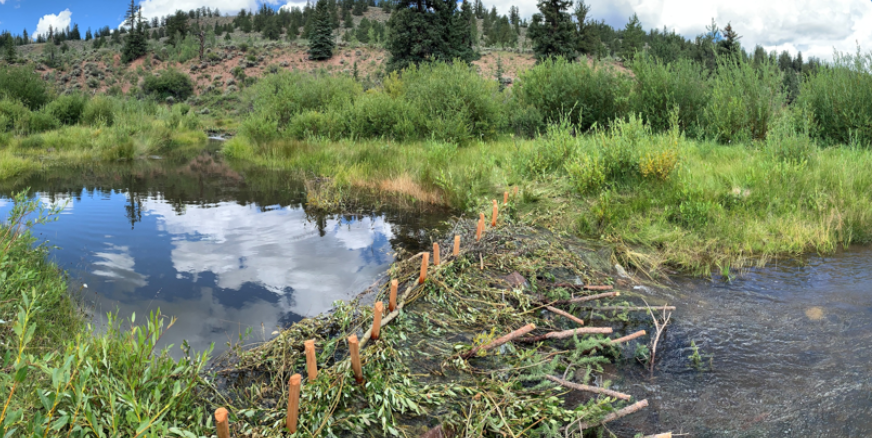
Beavers have long been known as a nuisance animal for their unsolicited tree removal and instinct to dam up water sources to create floodplains.
However, those exact instincts can play an important role in shaping landscapes that are resilient to flooding, drought and fire: by building their dams, they raise water tables, reconnect floodplains and improve fish and wildlife habitat.
As the thinking on beavers, and their important role in landscape management, evolves, land managers have looked to a new device in order to try and draw them back to the landscape–potentially encouraging new beavers to take up residence.
The beaver dam analog is a device made out of natural materials that can be strategically placed to recreate beaver habitat. However, beavers can still be a nuisance when the flood plains they create conflict with land use and other human activities.
In a recent study published in the Journal of Ecological Engineering Design, authors Hattie Greydanus (UGA), Brian Bledsoe (UGA) and Sue Niezgoda (Gonzaga University) introduced a new tool for helping land managers to make decisions about placing Beaver Dam Analogs.
In the study, they laid out three case studies to illustrate how hydraulic modeling might enhance beaver dam analog design. They then evaluated 9 different approaches for representing beaver dam analogs in a 2D hydraulic model at a site that experienced beaver recolonization.
Overall, they hope that the study will provide land managers with a place to start in incorporating hydraulic modeling and including beaver dam analogs in their work flows.
Read the full study here.